
Case study · AI
Knowledge Assistant.
Answers from your documents, with sources
We built an internal assistant that answered staff questions from the company's own documents — with a source link on every answer, and an honest 'not in the docs' when it didn't know.
Start your project →- Industry
- AI & automation
- What we built
- 3 integrated components
- Key outcome
- 1 source Cited on every answer
Overview
Turning scattered documents into answers.
A growing team's knowledge lived in folders, wikis, and PDFs — and finding the right answer meant interrupting whoever wrote it.
They wanted staff to get reliable answers from that content, with a way to check the source and no risk of the assistant inventing policy.
- Answers buried across scattered documents
- Repeated interruptions to the few people who knew things
- A need to trust answers — and verify them
- Sensitivity about where the company's data went
The goal was reliable, checkable answers from an agreed set of the company's own content.
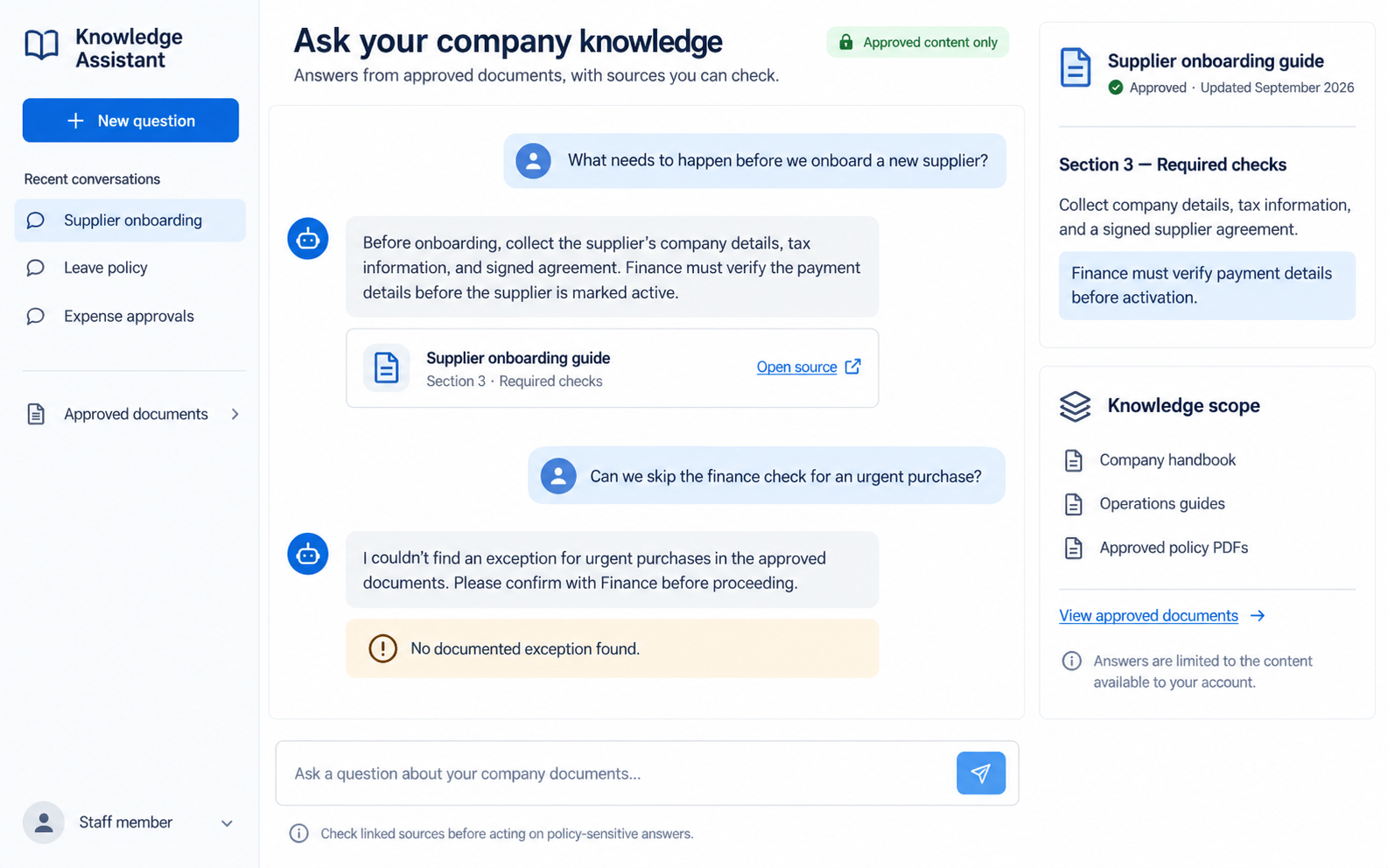
Experience flow
From a question to a cited answer.
The solution
A document-grounded assistant you can verify.
We built an assistant over an agreed document collection — answers cite their sources, and it says clearly when the content doesn't cover a question.
Core components
Grounded answers, verifiable sources, and controls on who sees what.
-
01
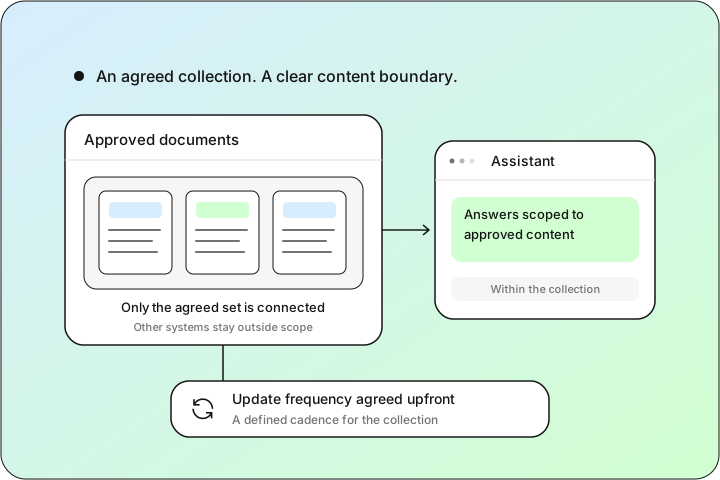
Agreed document collection
Content
Connected an agreed set of documents, not every system
Update frequency agreed upfront
Scoped so answers stay inside approved content
-
02
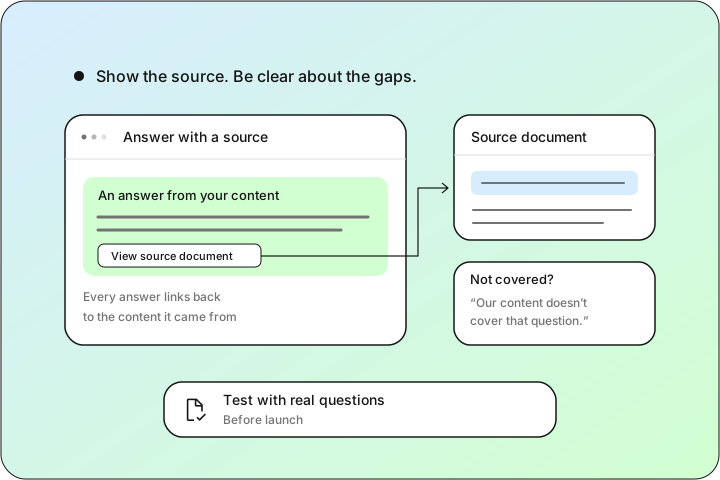
Cited, honest answers
Answers
Every answer links to the source it came from
Flags clearly when the content doesn't cover a question
Tested against real questions before launch
-
03
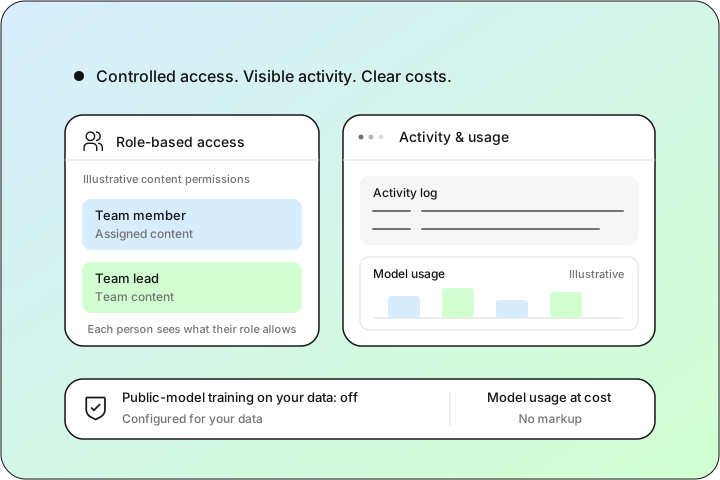
Access & safeguards
Controls
Role-based access to what each person can see
Activity logging and a basic usage dashboard
Configured so your data isn't used to train public models; model usage billed at cost
Stack used
- Next.js
- TypeScript
- Node.js
- PostgreSQL
- Prisma
- pgvector
- Python
- LangChain
- Anthropic
- Redis
Implementation approach
Phased delivery.
-
01
Agree the content
Chose the document collection, agreed update frequency, and set the retention and provider terms.
-
02
Build and ground
Connected the content, configured cited answers and the honest 'not covered' response, and added access controls and logging.
-
03
Test against real questions
Ran the assistant against the questions staff actually ask, tuned the responses, and trained the team.
Results
Outcomes at a glance.
- Cited answers
- Role-based access
- Private by config
The supplier handbook is ninety pages, and exactly one person had it memorized. Now the team asks the assistant and gets the answer with the section it came from — you check the source instead of taking anyone's word for it. Where the documents are silent, it says so and points us to Finance rather than guessing. Access is by role, everything is logged, and our auditor was genuinely pleasant this year. The expert still gets the hard questions; she just doesn't get 'which tax form' forty times a month.
- Freed the experts from repeated lookups
- Made every answer checkable against its source
- Kept answers inside approved content, with an honest fallback
- Controlled access and logged usage from day one
Impact & outcome
Answers you can actually trust.
We turned a company's scattered documents into reliable answers — grounded in an agreed collection, cited so anyone could check them.
The trust came from two choices: show the source, and say 'not in the docs' rather than guess. A confident wrong answer is worse than no answer.
With access controls and logging in place, the assistant was something the team could roll out widely instead of quietly piloting.
Knowledge buried in your documents?
We build assistants grounded in your own content — cited answers, access controls, and an honest 'I don't know'. We'll reply within one business day — no pressure, no sales script.
Start your project →