
Case study · Healthcare
Medical Analytics Platform.
AI-assisted clinical insight & outcome analytics
We designed a secure analytics platform that helped healthcare teams analyze patient data, identify clinical patterns, and evaluate treatment outcomes with AI-assisted decision support.
Start your project →- Industry
- Healthcare
- What we built
- 5 integrated components
- Key outcome
- 98% Registry rows matching source charts
Overview
Turning healthcare data into clinical insight.
A healthcare organization needed a secure analytics system capable of transforming fragmented patient data into useful clinical intelligence for providers, care teams, and operational leaders.
Patient records, lab results, treatment plans, and outcome data existed across multiple systems, making it difficult to identify trends, compare treatment effectiveness, and support faster clinical review.
The main challenges included:
- Disconnected patient data across clinical and operational systems
- Limited visibility into treatment outcomes and care patterns
- Manual analysis processes that slowed clinical decision support
- Strict privacy, audit, and access-control requirements for healthcare data
The goal was a HIPAA-aligned analytics platform that could support clinicians with explainable, data-driven insights without replacing professional medical judgment.

Experience flow
From fragmented records to clinical insight.
The solution
AI-assisted analytics for safer, smarter clinical review.
We developed a medical analytics platform focused on secure data aggregation, outcome analysis, risk signals, diagnostic support, and transparent reporting.
Core components
The platform connected patient data, AI-supported analysis, clinical review workflows, and reporting dashboards into one governed healthcare intelligence system.
-
01
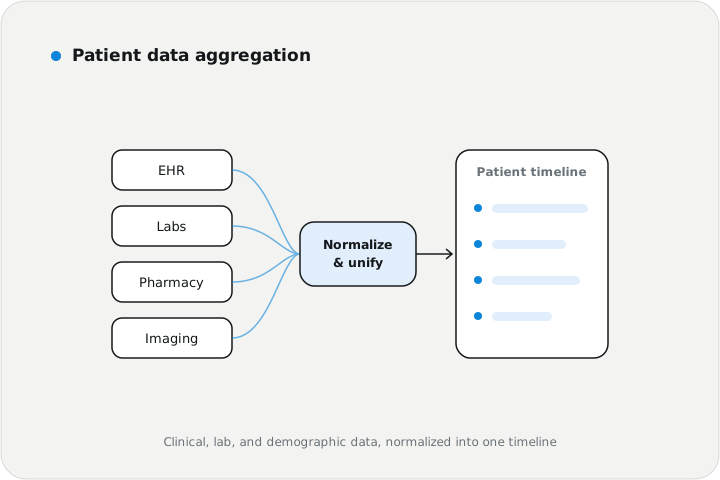
Patient data aggregation
Data
Unified clinical, demographic, lab, and treatment data
Structured patient timelines for provider review
Data normalization across multiple healthcare systems
-
02
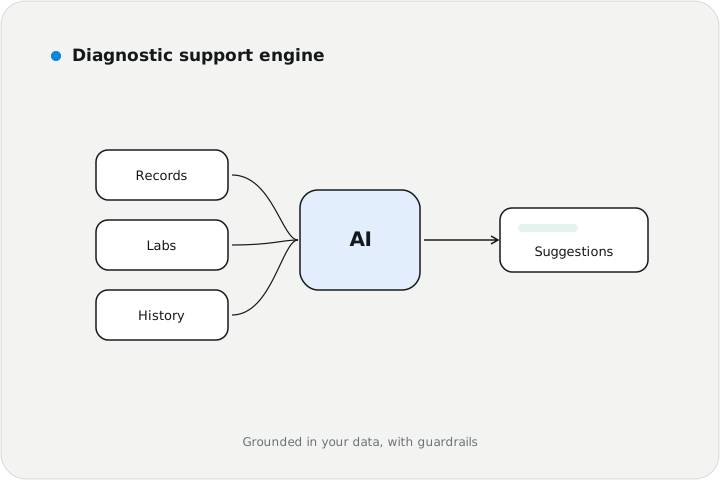
Diagnostic support engine
AI support
Pattern detection across patient history and clinical indicators
Risk signal highlighting for provider review
Explainable recommendations designed as support, not replacement
-
03
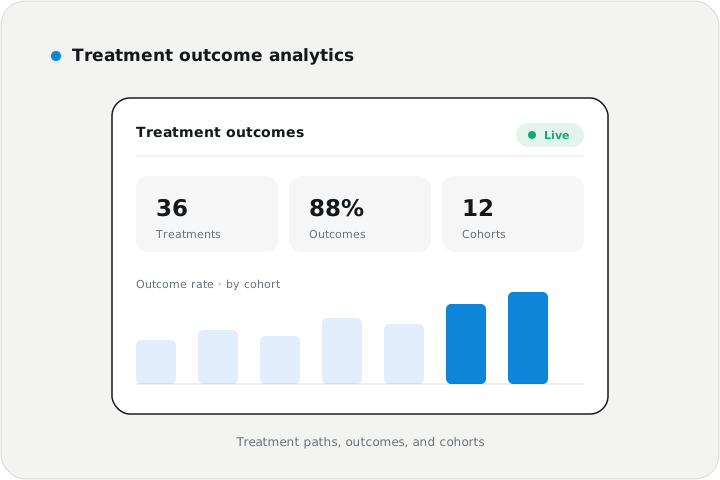
Treatment outcome analytics
Outcomes
Comparison of treatment paths and patient responses
Outcome trend dashboards for care teams
Population-level reporting for clinical improvement
-
04
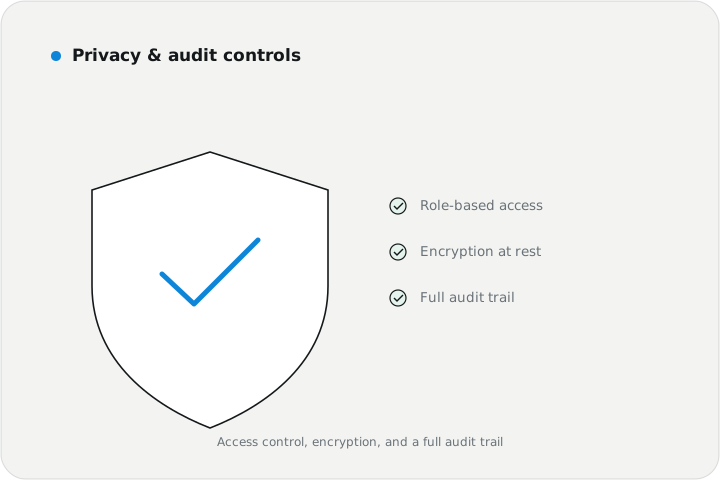
Privacy & audit controls
Governance
Role-based access to sensitive patient information
Audit trails for data access, analysis, and report generation
Security controls aligned with healthcare privacy expectations
-
05
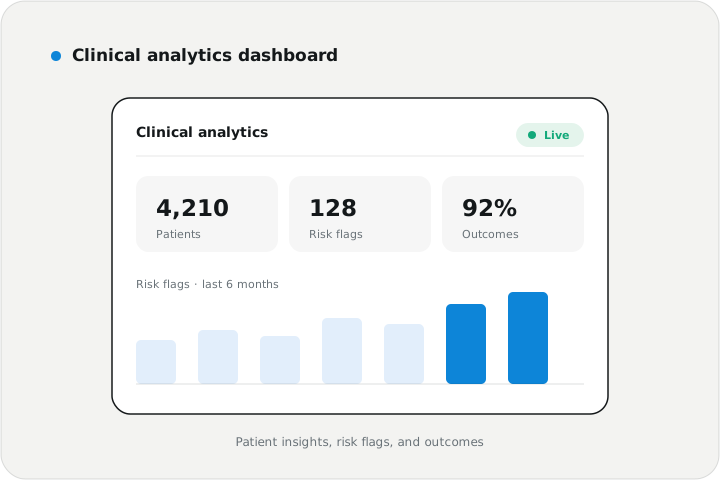
Clinical analytics dashboard
Dashboards
Provider-facing patient insights and risk indicators
Leadership views for outcomes and operational trends
Filters by condition, treatment type, cohort, and timeframe
Stack used
- Healthcare analytics platform
- AI diagnostic support
- Treatment outcome analysis
- Clinical dashboards
- Secure data pipelines
- Role-based access control
Implementation approach
Phased delivery.
-
01
Clinical data assessment
Mapped patient data sources, clinical review needs, privacy constraints, reporting goals, and outcome-analysis requirements.
-
02
Analytics model design
Defined data models, patient timelines, cohort filters, outcome metrics, risk indicators, and AI-support boundaries.
-
03
Secure platform build
Implemented data pipelines, access controls, audit logs, AI-assisted analysis, and clinical dashboard workflows.
-
04
Validation and launch
Tested data accuracy, model outputs, dashboard usability, permissions, audit behavior, and provider review workflows.
Results
Outcomes at a glance.
- Clinical intelligence
- Outcome analytics
- Privacy-aware AI
We're cautious about anything touching patient data, and the rollout felt slow — that was us, not them; every form went through compliance twice. But the outcome registries finally match the charts, and when leadership asks for evidence, it's one export instead of three weekends.
- Improved visibility across patient records, treatment history, and clinical indicators
- Supported providers with AI-assisted risk signals and explainable diagnostic support
- Enabled care teams to compare treatment outcomes across patient groups and timeframes
- Strengthened healthcare data governance through access controls and audit trails
- Created a scalable foundation for future predictive analytics and population health reporting
Impact & outcome
A governed analytics foundation for healthcare.
We delivered a secure medical analytics platform that helped healthcare teams move from fragmented data toward clearer, faster, and more structured clinical insight.
Medical AI must support — not replace — clinical judgment. This solution gave providers better visibility, outcome intelligence, and decision-support signals while keeping privacy, auditability, and human review at the center.
De-identification runs inside the clinic's network boundary, a constraint that slowed everything and satisfied everyone.
Need a secure medical analytics platform?
We build healthcare analytics systems for patient data, treatment outcomes, diagnostic support, dashboards, and secure clinical workflows. We'll reply within one business day — no pressure, no sales script.
Start your project →